
Ramblings
The Highest Hill in the Cotswolds
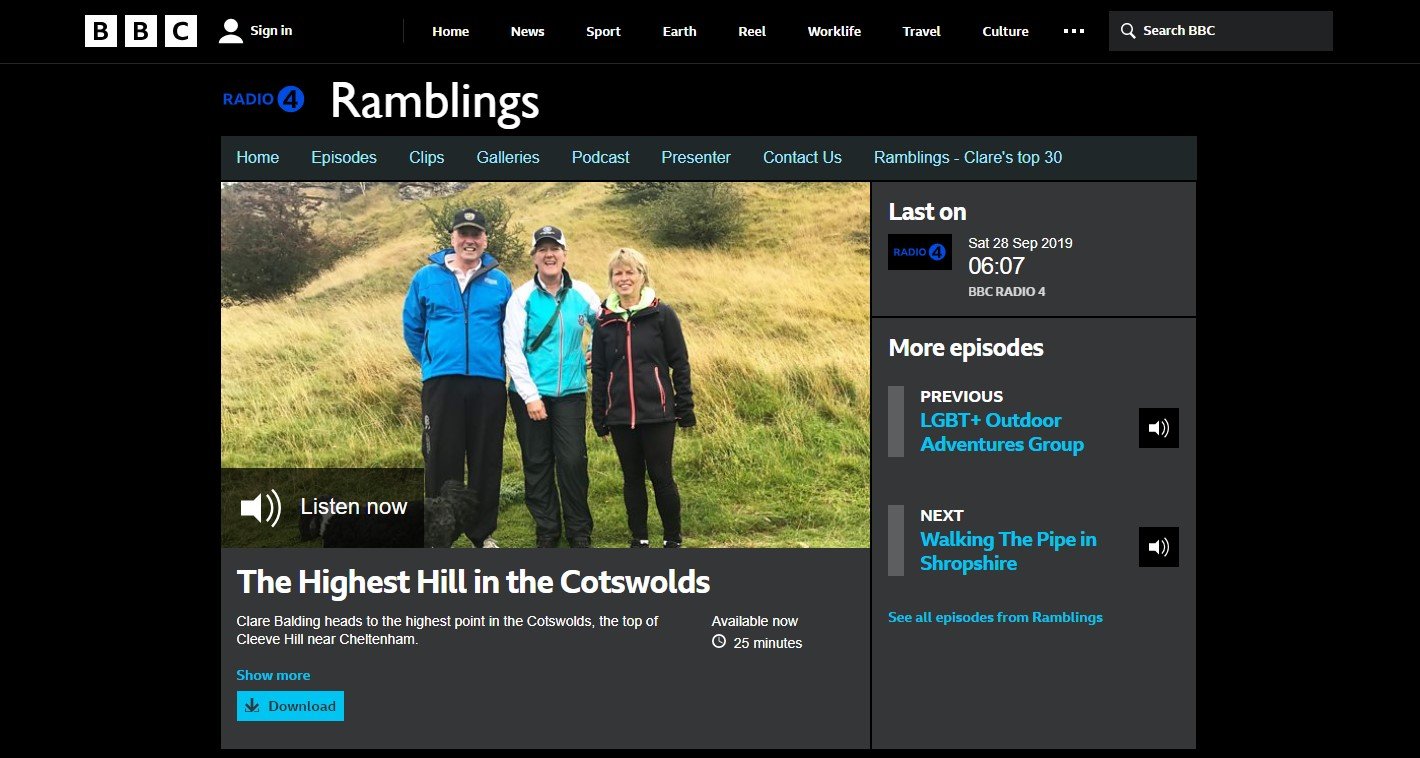
In 2019, Chas and his wife, Sue, were featured guests on Clare Balding’s Radio 4 show ‘Ramblings.’ In this episode, they climbed Cleeve Hill near Cheltenham, and Chas spoke about the significant role walking on the hill has played in his recovery.
BBC Sounds – Music, Radio, Podcasts.
0:06
Clare: It’s a grey, drizzly day—one of those days when the rain is just falling lightly, but there is no sign of it stopping at all. So if you love your walking, you just got to get out there and walk anyway. And I’ve come to Gloucestershire, just to the edge of Cheltenham. We are in the shadow of Cleeve Hill. And if you’ve ever watched the Cheltenham Festival, or any racing at Cheltenham, you’ll have seen Cleeve Hill. It’s the backdrop to a magnificent race course.
It’s probably not a great day to have brought Archie, but I have anyway—Archie being my dog, a Tibetan terrier. He’s 14 now. He’s not completely disobedient. He’s just wilful and has his own idea of where he wants to go, which isn’t always where I want to go. But anyway, luckily, the people I’m walking with are happy to accommodate his ways—Chas and Sue Howes—and Cleeve Hill, and walking on Cleeve Hill is particularly important to them. Archie, you don’t know where you are. So if you don’t keep up, it’s going to be difficult, okay? Come on.
—
1:09
Clare: So, Chas, what makes this place special?
1:12
Chas: It’s just such a fantastic part of the world, particularly on the top of Cleeve Hill. If you get it on a sunny day, the views are absolutely stunning. You can see 70 or 80 miles into South Wales. On a very good day, you can see the Bristol suspension bridge, which is about 45, 50 miles away. And you just, you look around, you get a 360 degree view because it’s the highest part in the Cotswolds actually, so at 330 metres or something. It’s just glorious. And particularly with wellbeing and health and all of those sorts of things, it is becoming more important.
1:52
Sue: When we first came here, we were renovating our house, and it was the builders that said to me—because I was a runner—they said, ‘You shouldn’t just be running on the flat. You should be running up those hills, Sue.’ So living here, that’s what started me running the hills. But in the end, that didn’t help my health either, but that’s another story.
2:12
Clare: Why? What happened?
2:14
Sue: Well, I’d been a hill runner for about 10 years, and then I just fell for no reason. But I fell and I hit my chest quite hard. Then the days after that I was breathless, and they couldn’t find what was wrong with me. So, I spent three weeks in hospital and in the end, I was diagnosed with atrial fibrillation, caused by high blood pressure that was being masked by my running.
2:48
Clare: Oh.
2:49
Sue: But at the time, they thought I’d got something a lot more serious. And I’ve now had to probably—well, I have. I’ve had to stop running up the hills and just walk, and run down the hills. But at the same time, the hill was my saviour when I was ill. It was fantastic. We would just all—not walk on the hill, but we used to go across. I’ve got to stop now. Sorry! I’ve got take some breaths. [Laughs]
3:19
Clare: I would describe where we are, but—
3:23
Clare: —I can’t actually speak.
3:24
Sue: No [Laughs]. We are on our way up to Cleeve Hill, past the Rising Sun pub. That’s the beginning. So this is the—where the Rising Sun Pub is, is where the end of the tramline used to come, back in the days where Cheltenham had a tramline. It stopped at Southam, but this was the final stop at the Rising Sun pub.
3:53
Chas: You might be interested, Clare, they used to hold Cheltenham races on the top of the hill here years ago.
3:59
Clare: Oh, really?
4:00
Chas: Yeah, for the first original races, before the course was there, before the racecourse was obviously constructed or built, and part of the purpose of the tram was to get people up here so that they could go and watch the horse racing on the hill.
4:13
Clare: Oh, right. You touched on this, Chas, the mental health benefits of walking. How personally have you found that living here and being able to walk up Cleeve Hill has helped you?
4:27
Chas: Frankly, immensely, actually. Because Sue and I come up here quite a lot, and I really enjoy being up here, obviously with her, and I also enjoy being up here on my own. You’re getting a bit of exercise; the surrounding environment is fantastic. Does it make a difference? Yes, I think it does.
4:44
Sue: Because I’m used to being an exercise person and get great benefits from my running, I probably encouraged you to come up more than you would probably want to.
4:53
Chas: Oh, yeah, you did. Yeah. Yeah.
4:56
Sue: So, when Chas was not feeling good about himself, then I used to say, ‘Right, come on.’ And he’d go, ‘No, no, no.’ And then once we were up here and out, the benefits were immeasurable really.
5:09
Chas: Yeah. I would tend, with my version of depression, I’d get very, very tired, and I just didn’t want to do anything. So Sue says, ‘No, come on, come on, you’ve got to do this.’
5:22
Sue: You used to lock yourself away really into your study.
5:25
Chas: Yeah, I did.
5:26
Sue: Because that was your business function. You were always used to going to an office every day. And the routine of that and everything getting on top of you, this was like a release really. And that’s why we can’t ever forget living on Cleeve Hill, for both of us really and our health.
5:46
Clare: What brought on the depression, do you know? Or is it not that straightforward?
5:50
Chas: I think I’ve had depression all of my life. It’s strange how it happens, and Sue knows exactly when it does happen. There’s a switch that goes off in my head, and it just goes like that—click. And it can be something completely innocuous that triggers it. And—
6:06
Sue: Or me.
6:07
Chas: Well, yeah, but as I spend most of the time with you.
6:10
Sue: Yes.
6:10
Chas: But if somebody says something that they probably don’t mean to be insulting, or offensive, or anything like that, a switch will go off in my head—click, I’ll feel absolutely awful. I go into a really, really dark place. I’ll switch off. I won’t talk to anybody. Eye contact becomes almost zero. And it was Christmas of 2016 when I got diagnosed. And at that point, I mean, I was suicidal. There were lots of tears, lots of grumpiness, not wanting to speak to anybody, not wanting to go out, and not wanting to meet anybody. And I think because in the past I’ve sort of always been busy and pressured at work—not stressed, because I don’t I don’t feel stressed, luckily—but pressured at work, that I could just forget it, and you’d put it to the back of your mind. And I remember I’ve been in various board meetings where I used to get severely beaten up. I was the finance director after all, that’s the game, right?
And then two or three days it would take me to get over that. And I used to think it was resilience that would get me out of it. And I don’t think it was. I think it’s just that my mechanism was repairing itself. So I now take medication. Interestingly enough, it’s the same medications as Alastair Campbell. And I don’t know if you’ve seen that program of him on depression, but that’s exactly how I get. So I really relate to what he’s going through.
7:34
Clare: The hard thing being the one who loves him and understands him and wants to heal him is understanding in a way that you can’t.
7:47
Sue: No.
7:47
Clare: So how did you deal with that?
7:50
Sue: Well, to begin with, it was like, both of us. Chas told me first, and I was so shocked I sort of blamed myself. I thought it was my fault—
8:01
Chas: Hold on …
8:01
Sue: No, no. But I did think it was my fault, why didn’t I know that he was feeling so low? Because we did have an episode in Brazil where you were in the sea weren’t you?
8:16
Chas: Yeah.
8:16
Sue: Oh, god. And to know that that’s—he was with the boys, who are—we call them boys—they’re 26 and 22, and he fell, or he went under the current. And now Chas tells us to this day, that if the boys hadn’t been there, that maybe the way in which he was thinking was, ‘What’s the point?’ And to know that, well, I’m going to get quite emotional now because—
8:45
Chas: Well, let me take over. Because this is a part of the landscape of a beach in Brazil where two pieces of water come together and create this little triangle where the waves get ‘stuck’. And the water sucks out, but it doesn’t suck you back in or push you back in. So I was there and I was swimming—I’m not a good swimmer particularly—but swimming as hard as I could and I wasn’t going anywhere. And there were these two, three foot waves coming over the top of my head. And I just thought, ‘Ugh, I’ve had enough,’ because—
9:18
Sue: The boys rescued you really.
9:19
Chas: They did. Yeah, they pushed me out.
9:21
Chas: But the interesting thing is when we were talking about it that Christmas, we were all around the table, including granny, and everyone thought that it was their fault—that I either didn’t like them, or they’d upset me, or something. And I thought, well, that’s lovely. That’s absolutely lovely. But it wasn’t that. It was because, as I say, this switch goes off. And the tablets that I now take just give me a little prop up that prevents the switch—if it does go off, it doesn’t go too far, and it recovers reasonably quickly.
9:53
Clare: In the business world, and obviously, you were a chief financial officer, you were very high up, very important, a lot of responsibility. The higher you get up the chain, is it actually harder to ask for help? Does anybody—is there a safety net for you? What’s the support like?
10:10
Chas: Unless people know, they’ve got nothing to support. You know, they don’t need to do it. So in a way, it’s up to the individual to say, ‘Look, sorry, guys, I’ve got a problem here.’ But the downside to that is that people who do do that probably think, ‘Well, that’s my career over.’ And there’s no doubt that I felt pretty similar actually. So you hide behind your personality, which is what I was doing. So everybody thinks, ‘Oh, yeah, he’s a jolly chap, you know. He’s great fun when he goes out,’ and so on. And, yeah, I can be, you know, like everybody else can be. But then when I go home, it’s cost me a hell of a lot because I’m having to force that personality out to prevent me dropping into somewhere really dark.
And then when you do get back and you wake up the next morning, I’d just feel awful, absolutely awful. It can change instantly. I can wake up feeling bad. And then the next time I’ll go out, the personality will come out, and it’ll probably cost me even more in a couple of days’ time. The difficulty is people probably think I can’t say anything about this because it’ll look like I’ve got a weakness. It’ll look like—with my career, they won’t give me too much responsibility. You know, I’m quite ambitious. I want to get on. And if suddenly people realise, well, actually, he’s got a mental health problem, they’d think carefully about what they’d do with you in terms of managing your career. So, invariably, I think that’s one of the main reasons why businessmen, particularly, keep it quiet.
11:40
Clare: You’re listening to Ramblings, and today I’m in Cheltenham, or just outside Cheltenham, Gloucestershire, walking up Cleeve Hill with Chas and Sue Howes, discussing the benefits of walking to mental health, but also the lack of conversation around mental health issues in business. And we just paused under the branches of a beech tree that’s stretched over the path. I’m waiting for Archie because he’s a bit slow these days. Come on, old boy. And above us—the honey-coloured Cotswold stone forms a cliff and the grass growing in great tufts down between it. And the clouds actually have lifted a bit. The wind’s picked up. It’s stopped raining, and those clouds are chasing across the top of that hill. And there’s a freshness to the breeze. I mean, really, it feels very autumnal. But I quite like the cleansing nature of a cold breeze.
12:33
Chas: So do I. My favourite time here is actually when it’s bright blue sky, sun, a stiff breeze, slightly chilly. And it just lifts your spirits. It just makes you feel so good. You know, you don’t have that cloud of depression over you.
—
12:50
Clare: As we walk up onto this ridge, we have a big massive valley to our left, a big ditch, and then natural walls of rock. I mean, it’s almost the best natural fort I’ve ever seen because it’s got the ramparts without having to build them. It’s got the ditch that could be a moat. And there are little tumuli that have footpaths leading up to the top of them because, clearly, people go up to stand on them to admire the view. Talk me through what we can see.
13:21
Chas: So on the left here is Leckhampton Hill sort of over the other side there. Then you’ve got Prestbury down in the front here just by the racecourse. And there’s the race course there. And then Cheltenham is sort of towards the left there. And if you just see, there’s a little gap in the hills, in far distance, that’s where you can see on a very clear day, you can see the Bristol suspension bridge through there. And then you come round and there are various hills and hillocks. And you’ve got Gloucester just over there. And then you come around a bit further, you’ve got the Malvern Hills. In between those two—
13:53
Chas: So the Malverns are over there. Yes, they are. But also over there, yeah, again, on a clear day, you can see the Welsh mountains, which are about 70, 80 miles away. You know, it’s just—
14:02
Clare: Gosh, so the Black Mountains?
14:04
Chas: Yeah, the Black Mountains. Yeah. And it’s just—you know, and we’re not even at the top yet.
14:08
Clare: Which way do you want to go? Are we going to go round the…
14:10
Sue: We’re going down, and then we’re going up to the hill to the—
14:13
Clare: And it’s soft underfoot from now, isn’t it? Archie was struggling a bit with the stones. I think that’s why he got so slow there.
14:19
Clare: Oh, he’s suddenly taken off. [Laughs] That was a little burst of energy from him.
—
14:27
Clare: Now we’ve nearly reached the top. Not quite—Sue says there’s a bit of a climb to come. But it feels to me as if we’re on this flat open downland at the top of the rocky steep climb. And it seems a good place, Chas, to talk about the road to recovery, which I imagine is a road that just continues.
14:46
Chas: Yep.
14:46
Clare: It’s not as if you’re going to find that perfect utopia at the end of it. But how are you now? And how do you feel you will be?
14:56
Chas: I think I’ve got to a point where I have a bit more stability. It’s not a road to recovery at all. It’s all about managing it, so doing things like this—coming up on Cleeve Hill for walking and doing more exercise, which I try to do, eating better—so I’m careful about the calories I eat and what I eat and all of those sorts of things. I work for two charities, which I absolutely love. And I do a little bit of angel investing (so, not serious), but I get more enjoyment out of actually helping the companies to grow and mentoring them about what they can and cannot do.
I do keynote speaking on brand management and brand creation, but I haven’t quite bought into it yet about having depression. I suspect that I will begin to start to do it now should I get any more events to speak at. Because I think it’s quite an interesting angle that now that I’m doing this, it might be a bit easier to talk about in front of, you know, 500 people or something. Well, I think all the things that I’m sort of doing physically, and me managing it by changing the things that I do, and what I eat, and how I behave, and so on has really only been possible—and this is terrible to say it—but because of the drugs that I’m taking. Because what it does, it just gives me a lift to be able to do it.
16:22
Sue: My thought though, is that actually having the tablets just masks what you’ve hidden underneath. So I’ve always suggested counselling, but you don’t want to do that, do you?
16:36
Chas: No.
16:36
Sue: Considering you’re talking about it now, but you don’t want to talk to a counsellor.
16:40
Chas: I know. Because—
16:40
Sue: So there you go. Clare, it’s you. [Laughs]
16:42
Chas: Because actually—
16:42
Clare: I’m very happy to listen. It’s felt like that. But actually, what’s interesting about it is it’s so clear that you haven’t talked about it before.
16:51
Chas: No, not really.
16:52
Clare: And that’s why, for me, it’s fascinating. But also the fact that we’re walking, and I say this often, I really think it’s easier to talk about things when you’re moving.
17:02
Chas: Yes.
17:02
Sue: Yes.
17:03
Clare: And where you’re not having to—you said eye contact can be a problem for you.
17:06
Chas: Yeah.
17:07
Sue: Yeah.
17:07
Clare: One of the things when you’re walking is you don’t have to make eye contact.
17:08
Chas: No, you don’t.
17:09
Sue: Nope. Do you think it’s because they might find out weaknesses?
17:16
Chas: I think the weakness is probably it. And I’ve told Sue, I haven’t told many people, but now I guess I’m going to tell a few, is that I’ve actually started to write a book about it. The title, for want of a better expression, is ‘Just Not Good Enough’. And I think that’s really at the heart of it. Because I just think I’m not good enough to be where I was and what I wanted to do. And that’s about the weaknesses coming through. And whenever we used to have performance reviews, I didn’t give a monkey’s about the positives that were coming up that said, ‘Chas, you’re really good at this or really good at that.’ I just focused on the negatives. And I still think about the negatives to this day, and I still—if something negatively happened to me 35 years ago, it’ll pop up and I will get that same feeling as if my switch has gone off.
18:08
Clare: I actually think this is all incredibly interesting, because I think a lot of people feel how you feel, where they think they’re meant to be strong.
18:19
Sue: Yeah.
18:21
Clare: And that they don’t want to discuss the thing that makes them feel the opposite of strong.
18:29
Chas: I’m getting nearer to it.
18:30
Clare: Well, maybe they’ll meet you on a hillside. I think they would do outdoor counselling if you wanted to.
18:33
Chas: Now that, actually, I would consider that, for sure.
18:37
Clare: You will find somebody who will do that for you.
—
18:41
Clare: Oh, we’ve just made that rise to the memorial stone and the tree here—
18:45
Chas: You can see the tree here.
18:45
Clare: —surrounded by a wall. And on it are loads and loads of plaques with people’s names and messages. I mean proper plaques that have been engraved and put here and for all people that love Cleeve Hill.
19:02
Sue: My brother is also up here. Unfortunately, he was a very fit rugby player, but he, oh gosh, how many years ago—seven years diagnosed, or eight years ago—
19:15
Chas: It was a bit more.
19:16
Sue: —with a brain problem that we thought was a tumour, but it wasn’t. But it was a virus. And in the end, he became disabled, and he fell and he hit his head, and yeah.
19:25
Clare: And that’s him, ‘In loving memory’.
19:26
Sue: Yes, it is. And so—
19:27
Clare: Paul Watmore. Watty, you called him?
19:29
Sue: Watty, yes. Yeah.
19:31
Sue: And this one, tat’s for—
19:31
Chas: That’s for us.
19:32
Clare: There’s a space there?
19:33
Sue: We saved a space.
19:34
Clare: Oh, you saved it have you?
19:34
Chas: Yep, yep, paid my donation, and they’ve put that there to save it. So this is where I’m going to be.
19:40
Sue: But it’s just nice. It’s just nice because—
19:41
Chas: Where all of us are going to be, actually, the whole family. You just look around you now. There’s 360 degrees of countryside and view and hardly a building in sight. You know, it’s just—
19:52
Clare: Yeah. It’s like being in the middle of the compass.
19:54
Clare: And there’s a bench looking in every direction.
19:56
Chas: Yeah.
19:57
Clare: And yes, pick your view and sit.
20:00
Sue: Absolutely.
20:01
Clare: Come on, Arch! Come on.
20:02
Sue: Archie’s going to rest after this, I’m thinking.
20:03
Clare: This way! Archie, Archie, Archie! This way!
—
20:07
Clare: We’ve just come past the trigpoint which has got the signs for the Cotswolds Way on it, and Sue is doing a very good job of moving rainwater off this disc, which is set on a stone wheel that is going to name for us all of the peaks around us. So, Leckhampton Hill, Painswick Beacon—what have we got there…Gloucester and Gloucester Cathedral. What’s that—
20:28
Sue: Black Mountains.
20:28
Chas: Black Mountains—
20:28
Clare: —oh, it’s the Black Mountains. Sugar Loaf! Oh, there’s Sugar Loaf!
20:30
Chas: —that’s 72 kilometres away.
20:33
Clare: Yeah. Sandhurst Hill.
20:35
Sue: This is the Malverns, I imagine. Where’s that? Worcestershire…Beacon.
20:38
Chas: It’ll be over there somewhere.
20:41
Clare: Brockhampton over behind us. There’s Sudeley Castle, which we saw, and Winchcombe, and Broadway. And Broadway Tower, I’ve walked up to there.
20:52
Sue: Cleve Hills—so that’s past Worcestershire.
20:55
Clare: They’re the Lickey Hills!
—
20:56
Clare: Oh, look at that now. I’m coming back down the hill that we huffed and puffed up at the beginning.
21:01
Sue: Yes.
21:02
Clare: And it has brightened up so much. You can really see the definition of the houses, but also the trees, which are just starting to turn in colour in that woodland up on the right. Oh, it’s glorious. Chas, how would you like to see the world of business change its attitude so that people like you do not have to come out of meetings feeling desperate about themselves?
21:29
Chas: It is a tough environment, there’s no doubt about it. And you’ve got shareholders who, frankly, are only interested in getting a return on their investment and what the share price is doing. In a way, they don’t sort of look beyond that. They just want the business to perform. And if you’re not up to it, then frankly, you’re out. So it’s quite hard to know what specifically a business environment can do. There is the opportunity to have a mentor when you get to a certain level.
21:58
Sue: Well, there you go.
21:59
Chas: So that’s somebody who has a conversation with you—a bit like a counsellor, I suppose—and just talks to you about what you’re doing, how you’re feeling, and all of that sort of stuff. And I have been in positions where that was an option. But funnily enough, I didn’t do it, probably because I’m reluctant in the same way of going to a counsellor that I didn’t do it. But that is definitely there. But I don’t know that people with mental health would actually take that up.
22:25
Clare: Okay, in sport, if you were a professional cricketer and you love your cricket, and you were told that you were going to go and see the team psychologist, the sports psychologist, you were going to have time with him or her on your own, and they said to you, ‘I can help you enjoy your cricket more. I can also help you perform better,’ you would go, ‘Yes, please.’
22:47
Chas: Yes, of course I would. Yeah, I absolutely would. But—
22:49
Sue: Perform better, you see.
22:51
Chas: But I don’t know of any other businessman that have got to—to blow my own trumpet here—a CFO of a PLC that’s FTSE 250, that has said, ‘Yeah, I’ve got depression actually.’ They’ve put their hand up and said, ‘I’m in trouble here, I need some help.’ I just don’t know of anybody, which is what sort of spurred me on to come and talk to you about it. Because I think it will help open doors for people in business to say actually, it is okay. But the other side to that, of course, is I don’t work anymore. I’m not looking for a job. So I have got a freedom of expression, if you like, and it’s not going to hurt me at all. But if I was 40 and coming to that nasty stage of your career, for me to put my hand up and say, ‘Sorry, I’ve got depression here,’ that would probably be it. But it’s quite interesting that hopefully, just this opens up a little door, a chink for somebody perhaps to walk through at some point.
23:44
Clare: Oh, I think it will. And thank you both so much for taking me to a place that I have seen from a distance for so many years, because obviously, being down at the racecourse looking at it. It’s just been such a pleasure. But more than that, to share what you’ve shared, and knowing that you haven’t really talked like this, it’s a real privilege. So, thank you. And I do think, Chas, I really do think what you say will not only help other people, but I think when you listen to it it’ll help you as well.
24:10
Chas: Okay. And if I do decide to go for counselling, you’ll be the first to know.